Louis Durra – piano,
Jerry Kalaf – drums
Domenic Genova – bass 1-6, 8-10
Barry Coates – guitar 07, 11
Sam Riney – flute 07
Jerry Kalaf – mixing / mastering Petra Rueth – graphics
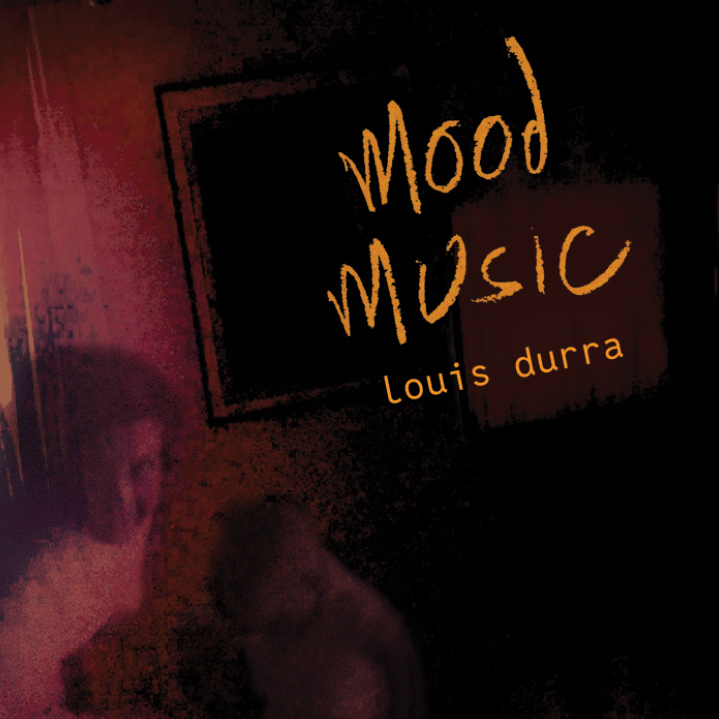
At home we all heard each other’s music. My mother liked a radio station that played orchestral versions of pop songs – “Mood Music” was one of the names for the genre. There was a willingness to let simple chords ring out, warm and direct. I think it expressed something about her. The album was inspired by her music tastes and a few things she said.
01 About the Same 5:15 (Louis Durra)
The title is from the phrase, “How’re things”? “Oh, about the same”. There’s an evening-walk-on-a-warm-beach quality to the playing
02 Mood Music 5:25 (Louis Durra)
The notes of the chords are displaced – a couple of notes here, a couple there. Bass and drums come in slowly. Domenic playing roots with “lyrical asides”.
The playing goes across the lines, reacting to, commenting on the melody. Perhaps
the music sounds cinematic.
The album was recorded in Los Angeles with old friends in Jerry’s studio. We could rehearse, leave things set up for the next day, listen back just a few feet from where we played.
03 Hold Fast to Dreams 4:55 (Louis Durra)
This is a nice group for … everyone disappearing into the music.
Each song found its own style of accompaniment. There wasn’t much said, the
sounds just developed through playing.
04 Strangers in the Night 4:04 (Bert Kaempfert, Charles Singleton, Eddie Snyder)
My mother’s favorite song. She often asked me to play it. Hearing her songs now is like remembering dreams.
I set out to do an album of “her” songs, and this was the frst one chosen. but I started writing music and the project developed in another direction.
This has been a polarizing song for musicians. Simple songs have their own challenges.
At some point in life I fgured out that resonating with other instruments, disappearing into the collective sound was part of my job as a pianist.
05 You-Know-What 4:19 (Louis Durra)
It’s nice having different recources to draw on. The melody sounds perhaps like a clarinet line from the big band era, but the harmonies are something else.
I used to try to be “unique” with my playing and writing. Reacting, absorbing sounds, and saying something through all of that are more interesting now.
The solos tend to develop out of the melodies. That affects how we accompany. The accompaniment evolves slowly – there aren’t any “away they go!” moments.
The bass solo comes frst … chromatic and tuneful both. Nice swing feel during the bass solo. Jerry’s playing … A lot of thought and nuance are going into his “ding
ding-a ding”!
06 The Tide 4:02 (Louis Durra)
I really like how this came out. Like water moving, like rippling water. I see pictures listening to this. Duxbury Reef, north of San Francisco, a place from my childhood with beautiful tide pools.
A recording can mark the end of one phase, the beginning of another
… the end of a perspective soon to be left behind, the beginning of
something from “tomorrow’s house”.
07 Tidal River, Mendocino 2:47 (Sam Riney, Barry Coates, Louis Durra, Jerry Kalaf)
Tracks 07 and 11 were recorded for another music project with Jerry, a band called “Looper Colony”. Sam Riney plays tenor fute on this track. The foating, sustaining sounds are from Barry Coates’ guitar. Barry passed away not long after the session. We miss him.
08 Gewitter 4:30 (Louis Durra)
The German word for thunderstorm. I pictured clouds darkening, the air pressure changing.
There are a few inversions, chords with different bass notes underneath. Gives an unsettled feeling. I love what Domenic is playing. Jerry is letting so much space go by – seems like a diffcult way to play.
Jerry has been like a mentor, we’ve done a lot of recording together.
09 Ned 5:05 (Louis Durra)
Written thinking about an author, Ned Vizinni … characters with observations, feelings, instability, some wisdom.
I try to have have the “necessary disrespect” for recording my own music. Even so, the freedom I’d like to have with my own music can be … diffcult to attain.
Slow and simple. Seems like Jerry never plays a downbeat. He just answers, like really-interesting-falling-leaves. Introverted music, thick. Just one section, but the number of bars keeps changing.
10 Can’t Decide 4:50 (Louis Durra)
The chords move between major and minor, like flm where you feel the camera jump. Jerry sounds great. The song slackens at the end, dropping down. Five-bar phrases, chords erasing the last ones. Jerry takes a long time to enter. He does an interesting-rain-falling-steadily-on-an-interesting-skylight thing … “what should I do when you play like that?” “whatever sounds good to you.”
I have an essential tremor. Have to think about steadying my hands when playing. A terrible thing to happen to a musician, of course. But it does give something. I’m thinking about my movements when playing. It connects me to myself, to my body.
11 Still Awake 1:56 (Sam Riney, Barry Coates, Louis Durra, Jerry Kalaf)
Barry on guitar again. Sounds like a loop, but we were playing live. Feels like lying still, hearing the sounds of the woods outside at night. This is an excerpt from a longer “Looper Colony” piece. I like what’s going on with the guitar echo – probably need headphones to really hear it.
An album is like a snapshot of the players and where we were at. A year later, everything can change. I like hearing how we were playing together at that time.